Poker Hand Analysis: 6-Step GTO Review
Good poker hand analysis is not a search for proof that a hand was unlucky. It is a reconstruction of the decision: what each player could hold, what actions were available, how much each action cost, and which assumptions change the answer. The repeatable workflow is simple: record the spot, build realistic ranges, check the price and equity, solve a matching tree when necessary, and convert one useful finding into practice.
This guide uses teaching examples rather than claimed solver outputs. Any frequency or EV you use for a real review should come from a completed run whose ranges, board, stack, rake and bet sizes match the hand.
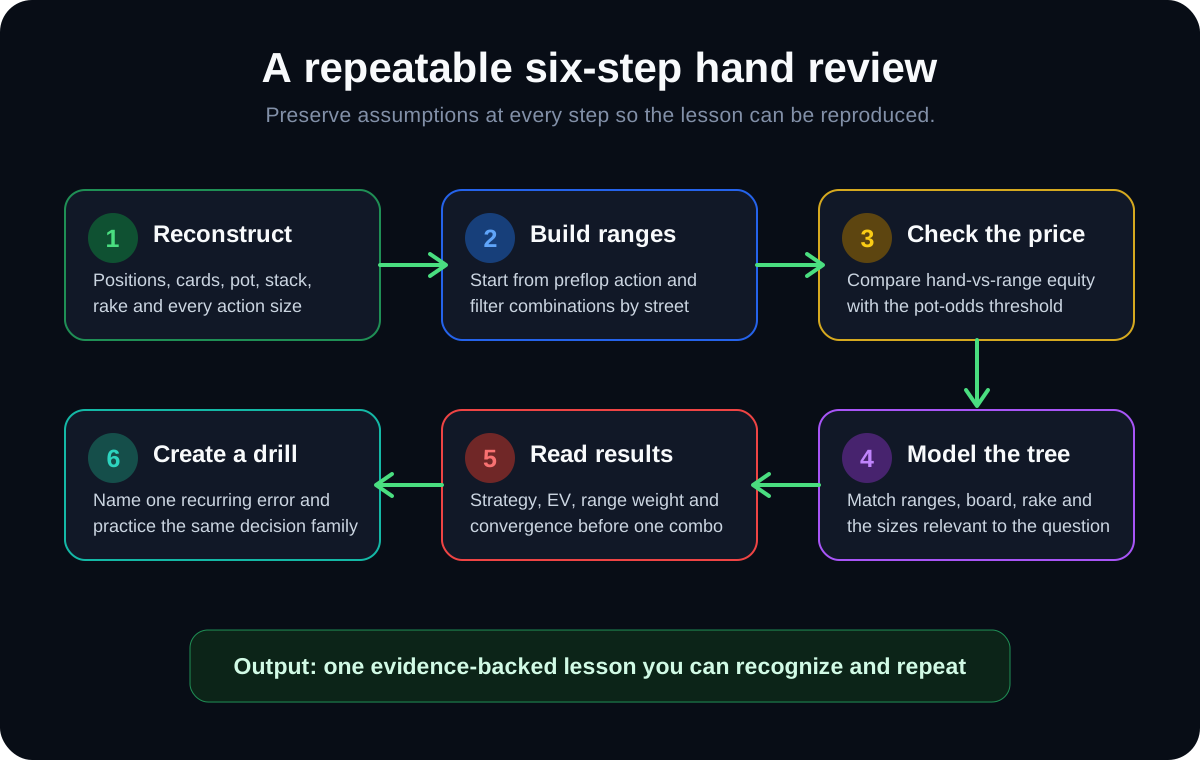
What good poker hand analysis looks like
A useful review evaluates decision quality, not the final card. A profitable call can lose this time. A poor bluff can win when the opponent folds. Results describe one outcome; analysis asks whether the action performs well across the opponent's plausible range.
Each review should answer five questions:
- Did I reconstruct the pot, stack and action correctly?
- Which hands plausibly reach this node for each player?
- What price did the action offer, and how much equity was needed?
- Which actions belong in the strategy under the chosen tree?
- What single pattern should I practice next?
Avoid giving the hand a score out of 100 or inventing a precise “GTO deviation” before you have a matching solution. Those numbers look objective but are meaningless without a defined reference strategy.
Step 1 — Reconstruct the exact spot
Write the hand before interpreting it. Missing inputs create larger errors than most close strategic choices.
| Field | What to record | Why it matters |
|---|---|---|
| Game | Cash or tournament, table size | Changes positions and incentives |
| Stakes and rake | Blind level, rake rate and cap | Changes marginal calls and opens |
| Effective stack | Shortest relevant stack in big blinds | Defines the remaining decision tree |
| Positions | Hero and every player still involved | Determines order and range width |
| Preflop action | Sizes, calls, raises and folds | Filters the ranges reaching the flop |
| Board | Exact suits and ranks by street | Controls blockers, draws and runouts |
| Pot and sizing | Pot before the action and amount to call | Determines pot odds and SPR |
| Reads | Only observed, relevant tendencies | Separates evidence from guesswork |
Use this compact template:
Game / players:
Stakes / rake:
Effective stack:
Hero position and hand:
Villain position:
Preflop action and sizes:
Flop / turn / river:
Pot before each decision:
Available sizes:
Observed reads:
Decision to review:
If the pot does not reconcile, stop and fix it. A small sizing error can change both the price of a call and the stack-to-pot ratio for later streets.
Step 2 — Set realistic ranges
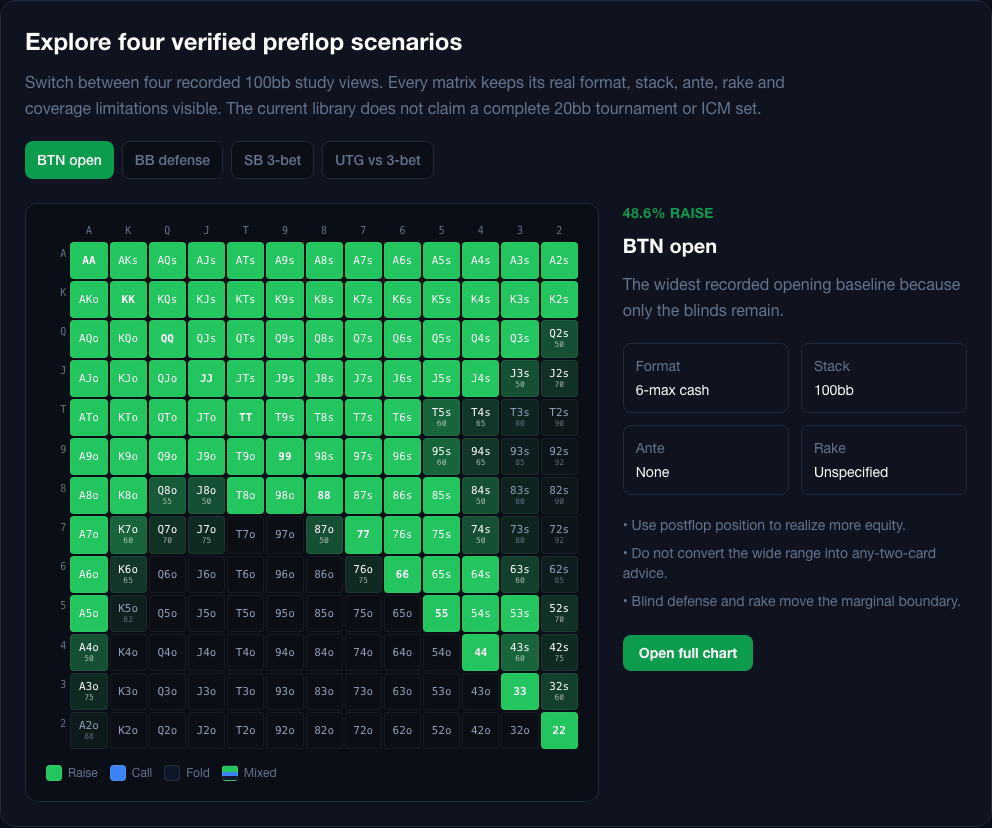
Begin with the preflop action. Do not give the opponent “any two cards” unless the action genuinely permits that range. Start from a chart or model that matches the format, position and stack, then remove combinations blocked by the board and observed hand.
PokerGTO Solver's free preflop chart library contains recorded 6-max cash study baselines at 50bb and 100bb. They are not universal solver exports: rake is unspecified, and opponent-specific charts marked adapted come from a manually simplified source with different table and ante assumptions. Use the labels as part of the analysis, not as fine print to ignore.
On later streets, filter ranges by the actions already taken. Ask which value hands, draws and marginal hands use the previous size. Keep more than one plausible range when the opponent is uncertain. If a conclusion reverses under a small, reasonable range change, the lesson is sensitivity—not a rigid rule.
Step 3 — Check equity and pot odds
Equity is your expected share of the pot at showdown against the selected range. Pot odds are the break-even threshold for a call before future action and other adjustments.
If the current pot is 15bb after the opponent bets and it costs 5bb to call, the final pot after calling will be 20bb. The raw break-even threshold is:
required equity = call / final pot after calling
                = 5 / 20
                = 25%
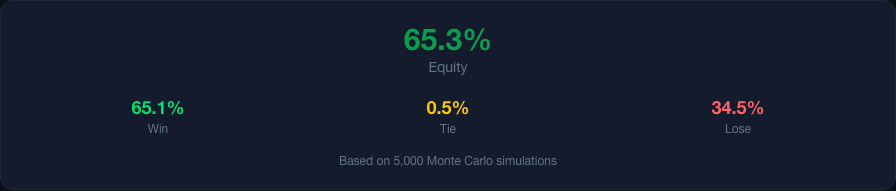
Use the poker odds calculator to compare a specific hand with a specific opponent hand or range. The calculator uses 5,000 Monte Carlo runouts, so results can vary slightly between runs. It does not calculate range-vs-range equity or decide an action automatically.
Equity above the raw threshold is evidence for calling, but not the whole decision. Future betting, rake, reverse implied odds, position and equity realization can change the value. On the river, where no cards remain, a clean call-or-fold comparison is usually simpler than on the flop.
Step 4 — Run a solver with explicit assumptions
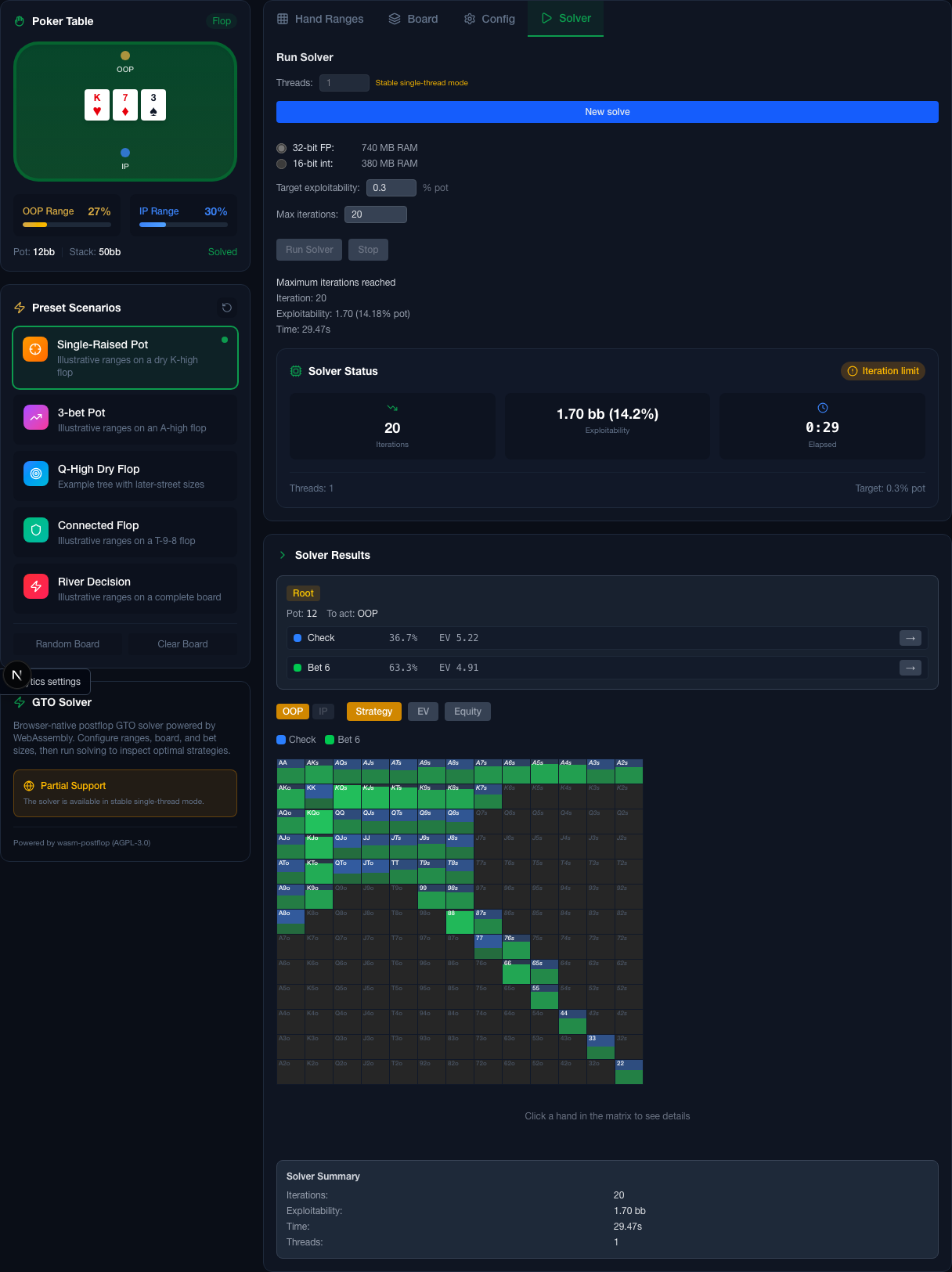
Use a solver when the action tree matters: competing bet sizes, mixed strategies, later-street responses or close EV differences. In the browser-based GTO solver, define one out-of-position range and one in-position range, choose the flop, and set the starting pot, effective stack, rake and allowed bet sizes.
Start with a small tree that represents actions players could realistically take. Extra sizes increase memory and computation. A converged solution to the wrong tree is still the wrong model for the hand.
Before interpreting the result, record:
- OOP and IP ranges
- flop and current node
- starting pot and effective stack
- rake percentage and cap
- allowed bets and raises on each street
- target exploitability and maximum iterations
- final exploitability and stopping reason
The public solver is designed for heads-up postflop Hold'em trees. Do not present its output as a multiway, preflop, tournament-ICM or node-locked solution.
Step 5 — Read strategy, EV and frequency
Read the range before the hand. Aggregate action frequencies show how the player divides the entire range. Individual combos then explain which blockers, hand strengths and draws populate each action.
| Output | What it means | Useful question |
|---|---|---|
| Strategy frequency | How often an action appears in the modeled equilibrium | Is this mostly one action or genuinely mixed? |
| Action EV | Expected value of an available action in the model | Is the practical cost of choosing differently large or small? |
| Equity | Showdown share against the modeled range | Does the hand win often enough, and can it realize that share? |
| Range weight | How much of a combo reaches the node | Is a dramatic-looking combo strategically important? |
| Exploitability | Remaining approximation error for the solved game | Did the run stop close enough for the question being studied? |
A 50/50 mix is not a command to flip a coin in every environment. First inspect the EV difference. If two actions are nearly indifferent, execution simplicity or an evidence-based exploit can matter more than reproducing the exact mix.
Step 6 — Turn one mistake into one drill
Do not end with “play better.” Label the error by decision family and create one small practice target.
| Finding | Drill |
|---|---|
| Opened or folded the wrong preflop boundary | Review one position and stack in Range Wizard |
| Used the wrong flop sizing family | Rebuild a small solver tree with the relevant sizes and compare range-wide frequencies |
| Over-folded a recurring postflop node | Review several matching hand histories, then test one representative model in the solver |
| Misread a close river call | Recalculate the pot odds and test two opponent ranges |
| Chose a size absent from the study tree | Rebuild the tree with that size and compare the result |
The goal is not to memorize one answer. It is to recognize the next structurally similar decision faster.
Three worked hand-analysis examples
Example 1: A preflop range mistake
Suppose you opened a marginal hand UTG at 100bb in 6-max cash. Open the recorded UTG 100bb chart, confirm the model label, and inspect the exact cell. The combo-weighted opening width in that recorded file is 10.5%, but that figure describes the dataset—not all 6-max games. If the hand is outside the baseline, the lesson may be “review the UTG boundary.” If the game has unusual rake or weak blinds, an exploitative adjustment is a separate claim that needs separate evidence.
Example 2: A flop sizing mistake
You reach a heads-up flop in position and choose a large c-bet because your exact hand is strong. Reconstruct both ranges and compare a small tree containing the size you used plus one plausible smaller size. Check the range-wide strategy before the combo. The useful lesson may be that the board favors a high-frequency small bet, that the large size needs a more polarized subset, or simply that the two sizes have a small EV gap. Report only what the completed model shows.
Example 3: A river bluff-catch
The pot is 20bb after the opponent bets, and calling costs 10bb. You need 10/30, or 33.3%, equity to break even before rake. Build at least two plausible betting ranges: one value-heavy and one with more missed draws. Since the river has no future cards, count how often your hand beats each range. If the decision flips between the models, the priority is improving the opponent range estimate rather than claiming one universal call frequency.
Poker hand analysis checklist
- The effective stack and pot reconcile.
- Positions, suits and every action size are recorded.
- Preflop ranges match the action and game assumptions.
- Blocked combinations are removed.
- Pot odds are calculated from the correct current pot.
- Equity is compared against a plausible range, not one convenient hand.
- The solver tree contains the action and size being reviewed.
- The stopping condition and exploitability are recorded.
- Range-wide output is reviewed before one combo.
- One finding is converted into one named drill.
Frequently Asked Questions
Can a solver tell me why I made a mistake?
A solver shows strategy and EV within a model. Explaining the result still requires comparing ranges, blockers, equity and available sizes.
Should I analyze every poker hand?
No. Prioritize large pots, repeated uncertainty, close river decisions, unusual lines and spots that represent a recurring pattern.
What information do I need for poker hand analysis?
Record the game, effective stack, positions, exact cards, preflop action, pot size, bet sizes, rake and any evidence-based reads.
How do I choose an opponent range?
Start from the preflop action, filter it street by street, and test more than one plausible range when the opponent is uncertain.
Is equity enough to decide whether to call?
No. Equity does not include fold equity, future betting, rake, position or the EV of the full action tree.
How do I turn analysis into practice?
Name the error category, choose one matching drill, and repeat a small set of structurally related decisions.